
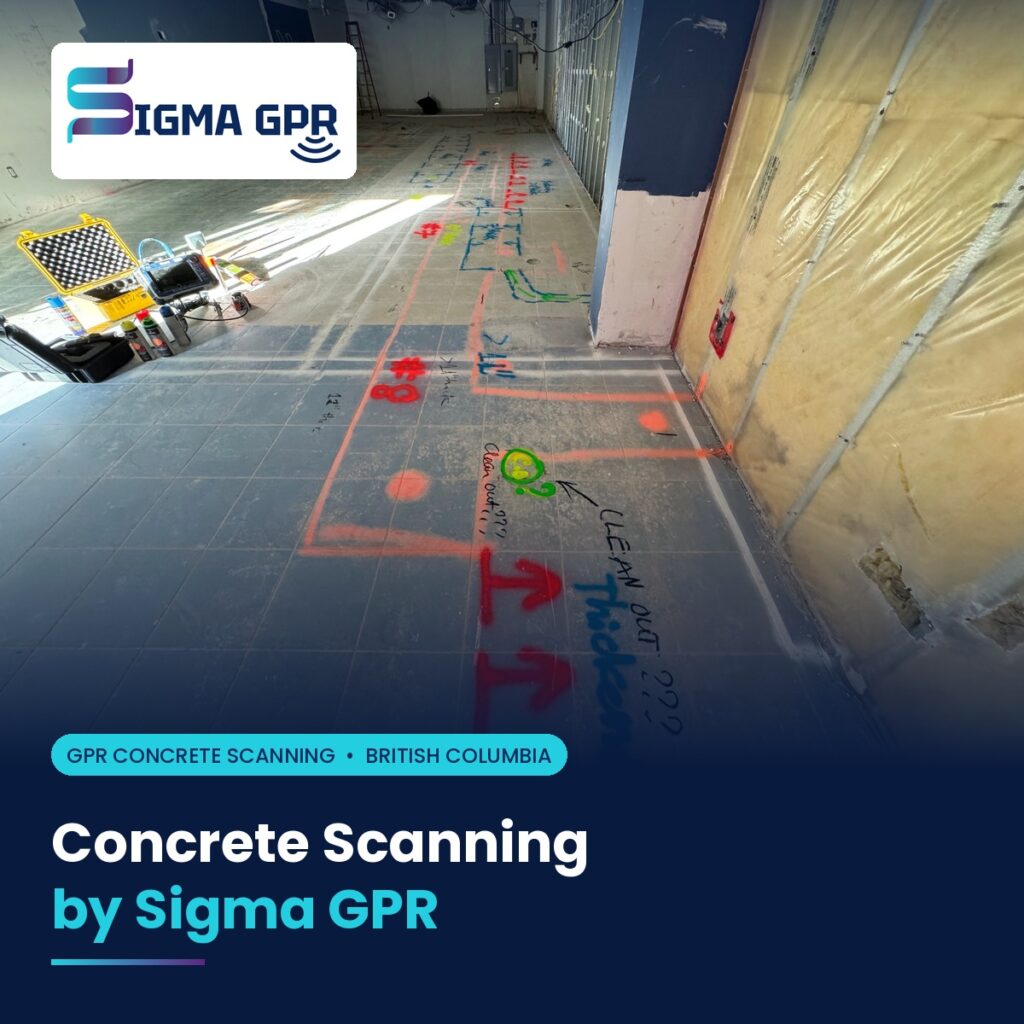
How long does a GPR scan take? For most jobs, one to a few hours on site. A single core location can be done quickly, while a full floor, a long trench line or a large site can take a full day.
The exact time depends on how many areas need scanning, how easy they are to reach and what we are looking for. Here is what to expect, and how to keep your scan on schedule.
Typical scan times
Job | Typical time on site |
|---|---|
One core or few anchor locations on one slab | About 1 to 2 hour |
Several cores across a floor or parkade level | 2 to 4 hours |
Saw cut or trench line through a slab | 1 to 3 hours |
Residential utility locate (yard, driveway) | 1 to 3 hours |
Commercial or roadside utility locate | Half a day to a full day |
Large warehouse, industrial floor or multi-level job | A full day or more |
These are typical ranges. Your quote will include a time estimate for your specific job.
What affects how long a scan takes
Number and size of scan areas. Ten core locations take longer than two. A continuous trench line takes longer than a single spot.
Access. Cleared floors are fast. Areas blocked by materials, equipment, racking or furniture slow the work down.
What we’re looking for. Rebar alone is quicker to map than a slab with post-tension cables, conduits and in-floor heating crossing each other.
Surface and conditions. Rough concrete, tile, standing water, very wet soil or snow can mean extra passes to get clear results.
Slab type. Post-tension slabs need careful mapping of every tendon near your locations, which takes more time but is essential.
Utility locating extras. A busy roadside or a site with many services takes longer than a single line across a yard.
What happens on scan day
- Walk-through. The technician confirms the locations and what you plan to do: core, cut, anchor or dig.
- Scanning. We scan each area in a grid or along the planned line.
- Marking. Rebar, PT cables, conduits or buried lines are marked on the surface, with depths where needed.
- Review with your crew. The technician explains the markings and points out safe zones before leaving.
Results are marked on site the same day, so your crew can usually start work right after the scan.
How to make your scan faster
- Mark every planned core, cut, anchor or dig area before we arrive.
- Clear tools, materials and debris from the scan areas.
- Make sure we can access the space, including keys, elevators and parking.
- Tell us if the slab may be post-tensioned.
- Have someone on site who can confirm final locations.
- Share drawings or as-builts if you have them.
For the full pre-work list, use our free Safety Checklist.
How soon can you book?
We usually quote within a couple of hours. Booking a few days ahead gives you the most choice of times. For urgent work, ask about our same-day rush option when you book.
Frequently asked questions
Do I get results the same day? Yes. Findings are marked directly on the concrete or ground during the visit. Report could be sent in 1 to 3 days.
Can you scan while other trades are working? Usually yes. GPR uses no radiation, so the area does not need to be cleared like it does for X-ray.
Does a single core really need a scan? Yes. One core in the wrong spot can hit a post-tension cable or a live conduit. Read Core Drilling Without Scanning: The Risk Isn’t Worth It.
What if you can’t finish in one visit? On large jobs we plan the work in stages and agree on the order with your team, so the crew can start on finished areas first.
Book your scan
Tell us how many locations you have and what you’re planning, and we’ll give you a time estimate with your quote.
Book a scan or call (778) 302-0868.